Remember 1996? That year, the United States Postal Service (USPS) debuted its first Hanukkah stamp. This stamp signaled the official inclusion of Jewish culture within the mainstream American holiday landscape. Over two decades later, these stamps have quietly evolved from traditional religious symbols into a moving artistic canvas. They document not only the holiday but also the process of a community being seen and expressed.
The Beginning: 1996, a Cultural Ice-Breaking Moment
Before 1996, if you looked at American holiday stamps, Santa Claus and Christmas trees would dominate the screen. So when the first Hanukkah stamp quietly came out, many people quietly sighed: It’s finally here.
This stamp, created by artist Hannah Smotrich, features a colorful, seemingly spinning top (Dreidel). Those familiar with this holiday will smile knowingly; it’s the laughter of children playing, the happiest memory of Hanukkah.
This is more than just a stamp; it’s a symbol. The U.S. Postal Service, in this way, officially embraces Jewish culture and gives thousands of Jewish families a nationally recognized holiday stamp of their own.
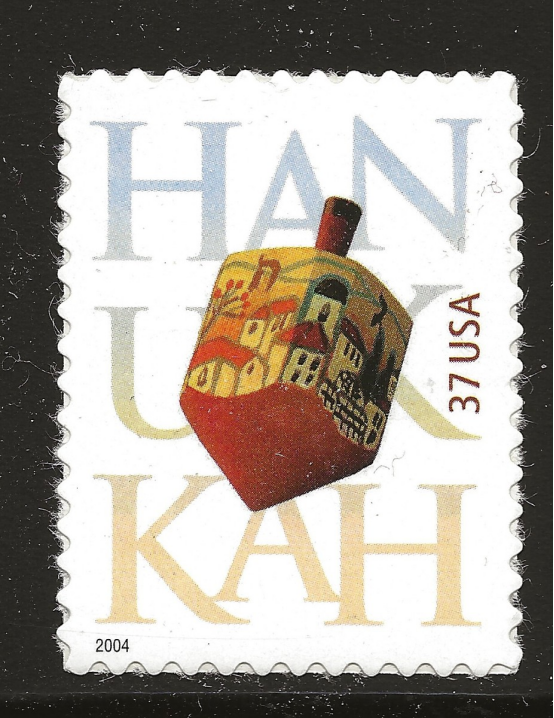
Early style (1990s-early 2000s): straightforward, but respectful
In the early years, the design style was calm and straightforward, without too many fancy techniques. The designers wanted to highlight the sacredness and tradition.
Menorah
After the spinning top, the candlestick became the main character. For example, the 2004 edition used realistic techniques to depict a classical and solemn golden candlestick, with bright candlelight and a solemn atmosphere – its religious significance can be felt at a glance.
The colors are also very particular
Traditional tones of blue, gold, and white appear repeatedly, creating a down-to-earth and solemn style that emphasizes a sense of heritage and sacredness.
Mid-2000s-2010s: Art begins to emerge quietly
Entering the 21st century, stamp design has become less serious , and artists have begun to try to incorporate modern aesthetics into traditional elements.
For example, the one from 2009 was inspired by paper-cutting art, while the one from 2013 resembles a stained-glass window. The candlestick is no longer just a candlestick; it has become a visual symbol, a play of color and light.
During this stage, designers also paid more attention to the performance of “light” – the flickering candlelight and the diffused warmth, the dynamic atmosphere where you can almost feel the temperature, began to be truly “printed”.
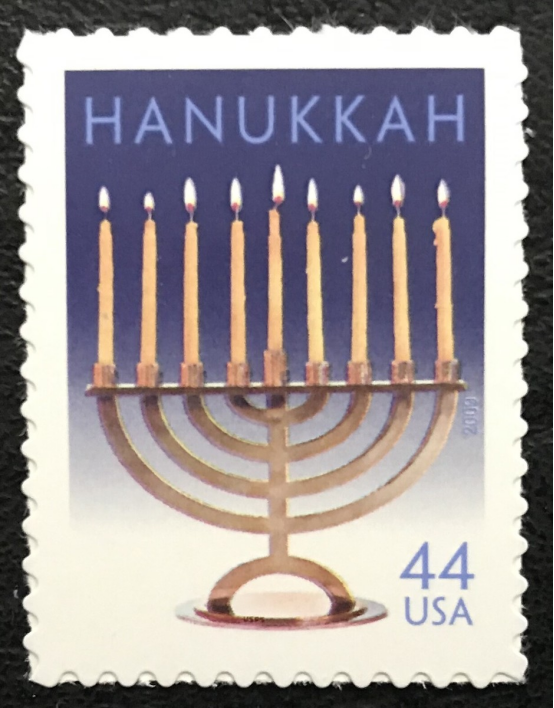
Recent (2010s-present): Modern, diverse, and incredibly confident
In the last decade, Hanukkah stamps have been freed up to become more distinct, refined, and even imbued with the artist’s personality.
For example, the one from 2019 has a large dark blue background with a clean and neat golden candlestick on it – if nothing else, it is visually eye-catching.
also begins to convey emotions that everyone can resonate with: hope, resilience, light… These themes transcend culture and touch people’s hearts.
What’s most admirable is that recent designs have increasingly emphasized the artist’s perspective. Each creator has infused their own understanding and cultural background into the stamp design . So, each stamp, while unique, all evokes the same heartwarming holiday.
What remains unchanged is Menorah
Regardless of its style, the Menorah remains the soul of Hanukkah stamps. Its evolution from a realistic religious object to a cultural symbol and then to an infinitely interpretable artistic theme perfectly mirrors the American Jewish community’s journey from recognition to confident expression.
Collection, more than just collection
For philatelists, the Hanukkah stamps are a series that has lasted nearly 30 years, with a clear design thread and constantly evolving style, making them of great collection value.
For ordinary people, they are more like a slice of culture. Stamps record the changes in social aesthetics and the process of a minority group becoming visible and respected by mainstream society.
I first encountered the Hanukkah stamp in 2013. I was struck by its modern stained-glass design and was struck by its modernity. It was then that I realized stamps could be more than just receipts; they could truly be works of art and cultural narratives.
Final Words
From the vibrant dreidel of 1996 to today’s diverse collection of contemporary designs, America’s Hanukkah stamps have undergone a heartwarming transformation. More than just postage vouchers, they are a piece of cultural history in the making.
Every Hanukkah, when people take out these stamps again, they seem to silently respond to the oldest belief of this festival: even in the darkest moments, as long as there is a little light, it can continue to spread and eventually illuminate everything.